

European Academy of Sciences Annual Symposium 2025: Hefei Session & EURASC Asia-Pacific Center Development Forum Successfully Held
Publishdate:2025-12-18 Views:11
Hefei Session of European Academy of Sciences Annual Symposium 2025 and EURASC Asia-Pacific Center Development Forum was successfully held in Hefei on December 17, 2025.
As the organizer, the China-Europe Electronic Materials International Innovation Center and the EURASC Asia-Pacific Center played a key role in fostering in-depth interaction between world-class academic resources and Hefei's industrial needs. The event featured addresses by Hefei municipal leaders and Professor Martins, President of the European Academy of Sciences, who joined via video link. Representatives from local universities, research institutes, and leading enterprises also gathered to explore collaborative opportunities.
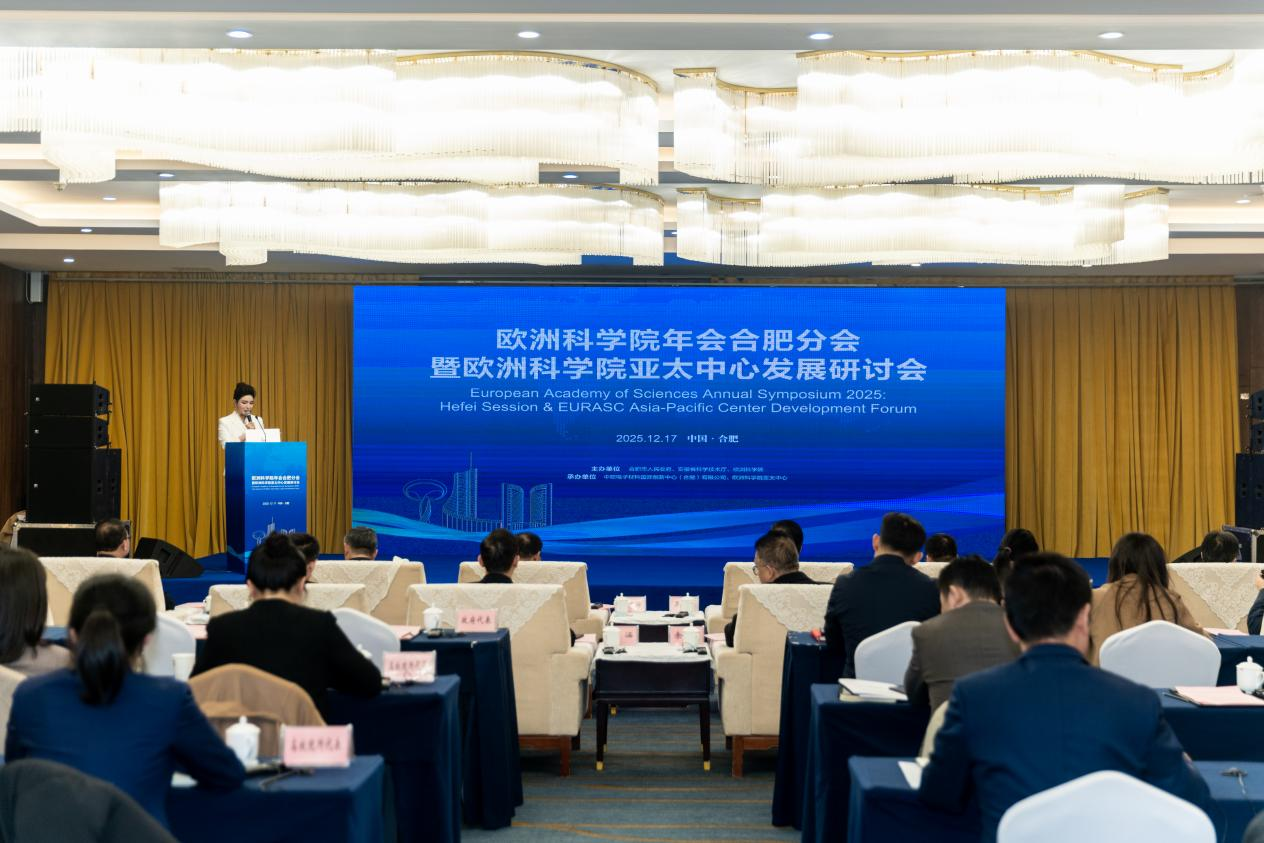
During the meeting, the EURASC Asia-Pacific Center released its work plan for 2026. The session facilitated exchanges between European delegates and representatives from interested local universities, research institutes, and companies on joint talent development, scientific collaboration, and results translation. Participants including Hefei University of Technology, Anhui University, Anhui University of Technology, and Anhui University of Chinese Medicine, as well as enterprises such as Anhui Jianghuai Automobile Group Co., Ltd and Anhui Hongyuan Jukang Medical Technology Co., Ltd., held online discussions with representatives from the European Academy of Sciences. Both sides engaged in in-depth dialogue on specific technological needs and cooperation pathways.
The successful holding of this conference demonstrated the role of the EURASC Asia-Pacific Center as as a hub for high-level international talent aggregation and scientific collaboration.. Moving forward, the EURASC Asia-Pacific Center will continue to utilize its global network to organize academic conferences and high-level forums, facilitating dialogue and cooperation between world-leading scholars, research institutions, and the local innovation ecosystem. This will provide sustained support for fostering a dynamic environment for international scientific collaboration on a global scale.
